Any Super Bowl party worth its salt wouldn’t be complete without a good old-fashioned game of Super Bowl squares. The beauty of this popular game is that it keeps the crowd engaged, is easy to play, and can reward the lucky winners with prizes.
Whether you’re a diehard NFL fan or just came to the party for nachos and commercials, Super Bowl Squares has a little something for everyone.
In this guide, you’ll learn how to set up the grid and assign numbers, how winners and payouts work by quarter and final score, which end digits people look for, a few simple strategy tips, where to grab a template, and how sportsbook-style squares compare.
How to play Super Bowl squares
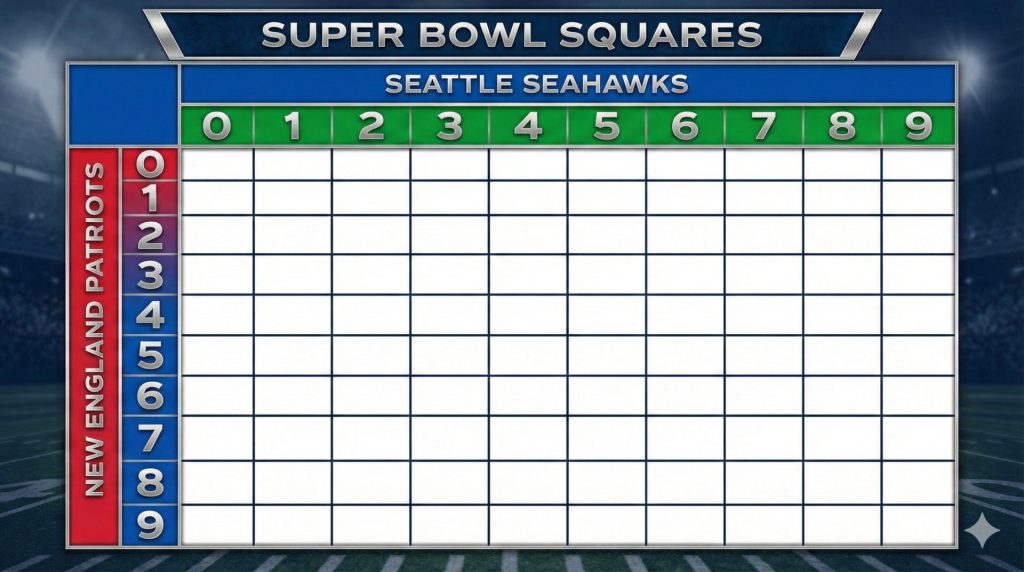
To play Super Bowl Squares, you set up a 10×10 grid, let players claim squares, and then assign 0–9 digits to each axis to determine quarter and final winners.
Create the grid
Start by drawing a 10×10 grid, giving you 100 total squares. That 10×10 setup is the most common, but some groups use smaller or larger grids (the rules work the same—you just have fewer or more squares to sell).
This can be done on paper, a whiteboard, or digitally using a spreadsheet or online generator. Each small square represents a possible score combination for the two teams playing.
Label the axes with team names
Once the grid is ready, label one side (rows) with one team’s name and the other side (columns) with the opposing team.
Some pools label the axes as “home” and “away” instead of specific team names, and either way works as long as everyone agrees which side belongs to which team.
These sides will later be numbered 0–9 to correspond with the last digits of each team’s score.
Important: In one approach, players pick squares before the 0–9 numbers are assigned.
Buy-in amount
Before players start choosing squares, decide on a buy-in amount. For example, $1, $5, or $10 per square, depending on how casual or competitive you want the pool to be. The total pot is then split among the winners at the end of each quarter, or you can make the final score worth the largest share.
Pick squares
Participants take turns selecting their squares until the grid fills up. Rules vary, but some formats let players pick multiple squares (e.g., Circa squares rules). Remember, the more squares you have, the better your odds of winning. Write each player’s name in their chosen boxes to lock in their picks.
Draw numbers for each axis
Once every square is claimed (or once you’ve decided you’re done selling), randomly draw numbers 0 through 9 for both the top and side axes. These numbers represent the last digit of each team’s score.
You only use the last digit because the grid is built around 0–9—so you’re matching the ones place of each score, not the full total.
For example, if Team A’s score ends in 7 and Team B’s ends in 3, you’d find where 7 and 3 intersect to determine the winner for that quarter.
Handle blank squares
If not every square sells, you can keep the game fair by choosing one simple rule up front, like:
- “House” squares: unsold squares belong to the organizer/house (and can win).
- Reduce the pot: only pay out what was actually collected (squares sold × buy-in).
- Reopen sales at a discount: let people grab the remaining squares before kickoff.
- Lock sales early: stop at a set time and run it as-is with your chosen rule.
Whatever you choose, state it clearly before kickoff so nobody’s surprised later.
With the grid filled and numbers assigned, you’re ready to track winners at the end of each quarter.
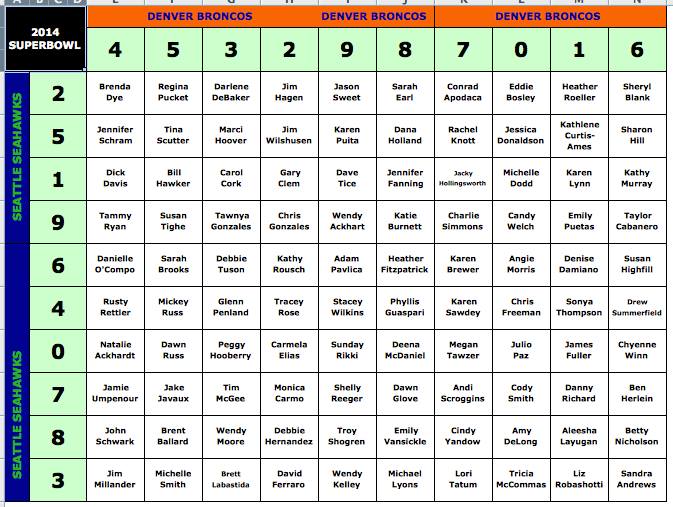
Here is an example of a 100-square Super Bowl squares template board pulled from Google (note the team names on each axis, with the numbers assigned horizontal axis going to the final score of one team, while the vertical axis is for the other team):
How payouts work
Super Bowl Squares payouts are determined by the last digit of each team’s score at set checkpoints (quarters and final), using a payout split you define in advance.
Winning conditions by quarter and final
Super Bowl Squares typically award prizes at the end of each quarter, based on the last digit of each team’s score at that point in the game.
For example, if Team A leads 17–10 after the first quarter, the winning square is where Team A 7 and Team B 0 intersect.
Another quick example: if the score at a checkpoint is 38–35, the winning square is the intersection of 8 for the 38 team and 5 for the 35 team.
The same process repeats after the second and third quarters, and again for the final score.
Note: Rules vary by pool. In some Squares formats, winning selections are paid once even if the same combination appears again, and cannot win twice.
Common payout structures
One approach is to divide the prize pot between the four quarters, giving everyone multiple chances to win. Another approach is to increase payouts for later quarters (especially the final score), since the excitement peaks near the end.
Another simple way to think about it is you can pay smaller prizes for the first three checkpoints and reserve the biggest share for the final score.
Example splits include:
- 25% / 25% / 25% / 25%.
- 20% / 20% / 20% / 40%.
- 10% / 20% / 30% / 40% (more “late-game heavy”).
Example payout breakdown
If your pool sells all 100 squares at $10 each, the total pot is $1,000. You could split it evenly into $250 per quarter. Alternatively, you could go with $150 for the first three quarters and $550 for the final score.
If the grid doesn’t fill, a clean approach is: pot = squares sold × buy-in, then split that pot using your chosen percentages.
Overtime rules and payout impact
If the Super Bowl goes into overtime, most organizers treat OT as part of the fourth quarter and final score, meaning the final score after overtime determines the last winning square.
If you choose to create a separate “overtime prize,” you’ll want to decide where the extra money comes from (e.g., shave a little off the 4th/final payout) and make it clear before kickoff.
State your payout split and overtime rule before kickoff so everyone knows how winners are determined.
Which numbers are best for squares?
While Super Bowl Squares is mostly a game of luck, certain last digits show up more often in football scores. That said, it’s important to understand when this actually matters.
The key thing most people miss
The key thing most people miss is that in a standard Squares pool, players pick squares before numbers are assigned. That means you can’t really “choose good numbers” — every square is equally likely at the moment you buy it.
The “best numbers” conversation becomes useful mainly when:
- Your pool assigns numbers before selection (a different variant), or.
- You’re buying late and can see which rows/columns ended up with which digits.
Best numbers based on score frequency
Historically, the most common last digits in football scores are 0, 3, 4, and 7. These digits show up more often because scoring frequently comes in 3s (field goals) and 7s (touchdowns + extra point), and 0/4 also tend to appear naturally as drives add up.
Combinations like 7–0, 3–0, 7–7, 4–7, and 0–0 tend to be popular because they “fit” typical scoring patterns.
Numbers to avoid and why
For numbers to avoid, digits like 2, 5, 8, and 9 are generally less common, and here’s why. They can still happen (safeties, missed/blocked extra points, two-point conversions), but they’re usually less “natural” outcomes.
Score history insights
For score history insights, some digits do hit more often over time — but nothing is guaranteed. Missed kicks, two-point attempts, defensive scores, and weird end-of-half drives can throw expectations off entirely.
The key takeaway: use number trends as a fun reference, not a promise of success.
Squares strategy
Even though Super Bowl Squares is mostly a game of chance, a little strategy can help you get the most fun out of your entries — as long as it’s the kind of “strategy” you can actually control.
What actually improves your odds
What actually improves your odds in a standard pool is limited, because all squares are equal once numbers are assigned after selection. If you want to cover more squares, you can buy more squares (within your budget) or join more than one pool (if you want more sweat on the game).
If you’re buying multiple entries, you can spread them across different rows and columns to get more digit combinations. Spreading entries gives broader coverage, while concentrating entries gives you more exposure to the same few combinations.
Size your bankroll for the pool
To size your bankroll for the pool, decide in advance how much you’re comfortable spending based on the pool’s buy-in. For casual office or party games, this might mean buying one or two $5 squares, while larger pools may call for a few more entries.
Keep it fun and affordable, then decide whether to spread entries across rows/columns for better digit coverage. A clear budget keeps the focus on the excitement of the game, not the money at risk.
Match your approach to the payout rules
Always check the payout rules. Some pools reward each quarter equally, while others pay more for the final score. If the final score is heavily weighted, prioritize broader row/column coverage over clustering entries within the same row or column. In smaller pools with lots of unsold squares or house squares, the value of “coverage” can change—confirm the rules before buying extras.
With a balanced mix of smart planning and good luck, you’ll be ready to enjoy every touchdown, field goal, and final whistle with a little extra excitement riding on the score.
Where to find a squares template
Setting up your Super Bowl Squares game is easier than ever, thanks to ready-made templates you can find with a simple Google search.
Whether you’re running the pool at the office, in a classroom, or during a party, a downloadable grid or online generator can help you organize everything quickly and keep the game running smoothly.
Download a printable grid
You can easily find free printable Super Bowl Squares templates online. These grids come preformatted with 10 rows and 10 columns. All you have to do is print them out, label the top and side with the teams playing, and start filling in names as people claim their squares.
Printable versions are perfect for in-person gatherings and let everyone see the action at a glance.
How to use the template
To use the template digitally, use an online generator or spreadsheet version instead. These tools can assign numbers to each axis, track who picked which squares, and make it easy to share with a group so remote friends can join without confusion or delays.
A simple, practical workflow for remote groups is:
- Put the grid in a shared spreadsheet (view-only for most people).
- Collect picks in chat or a form.
- Fill in the names yourself (or let one trusted co-host do it).
- Assign numbers once sales close.
Whether you go paper or digital, using a template keeps your Super Bowl Squares organized, fair, and fun for everyone involved.
Do sportsbooks and DFS sites offer squares-style contests?
Super Bowl Squares aren’t just for office pools anymore. Some sportsbooks and daily fantasy sports (DFS) platforms have started offering their own versions of the classic game.
Where you can play
Major sportsbooks and DFS apps may feature Super Bowl Squares-style contests during the Big Game, either as special promotions or limited-time pools. The setup is usually similar to traditional squares, but with digital grids, automatic number draws, and real-time updates.
Availability varies by platform and location, so it’s worth checking a few options as the Super Bowl approaches.
Why format and limits matter
Each platform can differ in entry cost, payout structure, and entry limits. Some contests allow multiple squares per player, while others cap entries to keep odds balanced. Pay attention to timing too — entries often close before kickoff.
Also note: sportsbook/DFS versions may have different rules than a home pool (fees, prize formats, bonus credits vs. cash, and so on), so it’s worth reading the terms.
How to choose the right option
To choose the right option, compare the rules, payouts, and any fees across platforms before entering. Look for licensed operators and read the rules to understand the entry limits, payout format, and timing.
Whether you’re in it for fun or aiming for a payout, picking a well-structured contest helps you enjoy the Super Bowl Squares experience without any surprises.
Frequently asked questions (faq)
Use this FAQ to lock in the key rules (number assignment, repeat winners, unsold squares, and variants) before anyone buys a square.
When should you assign the 0–9 numbers?
One approach is to sell squares first, then assign numbers. That keeps the game fair because nobody can “shop” for strong digits.
Can a square win more than once?
Yes—depending on the rules. In some Squares formats, winning selections are paid once and cannot win twice.
What if the grid doesn’t fill up?
If not every square sells, decide the rule up front. You can let unsold squares belong to the organizer, reduce the pot to what was collected, reopen sales before kickoff, or lock sales early and run it as-is. Whatever you choose, state it clearly before kickoff.
What if someone asks to pick numbers instead of squares?
That’s a different variant. In a traditional Super Bowl Squares pool, people pick squares before the numbers are drawn. If you assign numbers first, it changes the game and invites “better number” chasing.
What are “reverse squares”?
Some pools use reverse squares (same grid, but the winning digits are swapped—e.g., you flip which axis corresponds to which team). It’s not required, but if you use it, say so clearly before kickoff.