In this weekly feature, we analyze some of our favorite golf props and DFS PGA picks for Rounds 2-4.
Early in the week, we may post some of our favorite winner plays, and we’ll then check in with our favorite selections for Round 2, Round 3, and Round 4.
Top DFS Apps in All States





Golf Props Today – Round 2/3/4 Picks
Every week, we examine Rounds 2, 3, and 4 from a DFS and betting perspective.
The PLAYERS Championship – Round 4
Who will take home the trophy at The PLAYERS? It’s Ludvig Aberg’s to lose, as he’s three shots up on the rest of the field heading into the last day.
Leaders in strokes gained: tee to green through three rounds (via Data Golf):
- Ludvig Aberg (+3.74)
- Austin Smotherman (+3.55)
- Ryo Hisatsune (+3.00)
- Michael Thorbjornsen (+2.91)
- Corey Conners (+2.87)
- Matt Fitzpatrick (+2.70)
- Xander Schauffele (+2.67)
Leaders in strokes gained: approach:
- Corey Conners (+2.31)
- Ryo Hisatsune (+2.30)
- Adam Scott (+2.18)
- Austin Smotherman (+1.97)
- Xander Schauffele (+1.91)
- Cameron Young (+1.74)
- Sahith Theegala (+1.73)
Notable positive ballstriking/poor putting performances from yesterday:
— Jordan Spieth (+0.55 T2G, -5.09 Putting)
— Tommy Fleetwood (+1.49 T2G, -3.03 Putting)
— Sam Stevens (+2.30 T2G, -2.83 Putting)
— Rory McIlroy (+1.82 T2G, -2.36 Putting)
Top Round 4 Plays
A quick overview of our favorite golfers
Xander Schauffele < 70.5 Round Strokes
Check back for finalized picks and analysis.
Good luck!
Editor’s Note: Did you know DFS pick’em apps like Underdog and Sleeper are live in many states where online sports betting isn’t yet legal? Use promo code PROPS to get top-tier sign-up bonuses!
The PLAYERS Championship – Round 3
Ludvig Aberg fired a -9 score in Round 2 and leads by two over Xander Schauffele at -12. It should be an amazing weekend at the PLAYERS Championship, with a host of others in contention for the trophy heading into Moving Day.
Leaders in strokes gained: tee to green through two rounds (via Data Golf):
- Ludvig Aberg (+5.29)
- Xander Schauffele (+4.97)
- Cameron Young (+4.79)
- Corey Conners (+4.74)
- Austin Smotherman (+3.89)
- Brian Harman (+3.33)
- Jason Day (+3.00)
Leaders in strokes gained: approach:
- Xander Schauffele (+3.77)
- Adam Scott (+3.70)
- Corey Conners (+3.25)
- Cameron Young (+2.79)
- Ludvig Aberg (+2.69)
- Austin Smotherman (+2.42)
- Ryo Hisatsune (+2.33)
Notable positive ballstriking/poor putting performances from yesterday:
— Jason Day (+4.80 T2G, -2.42 Putting)
— Nico Echavarria (+3.23 T2G, -1.85 Putting)
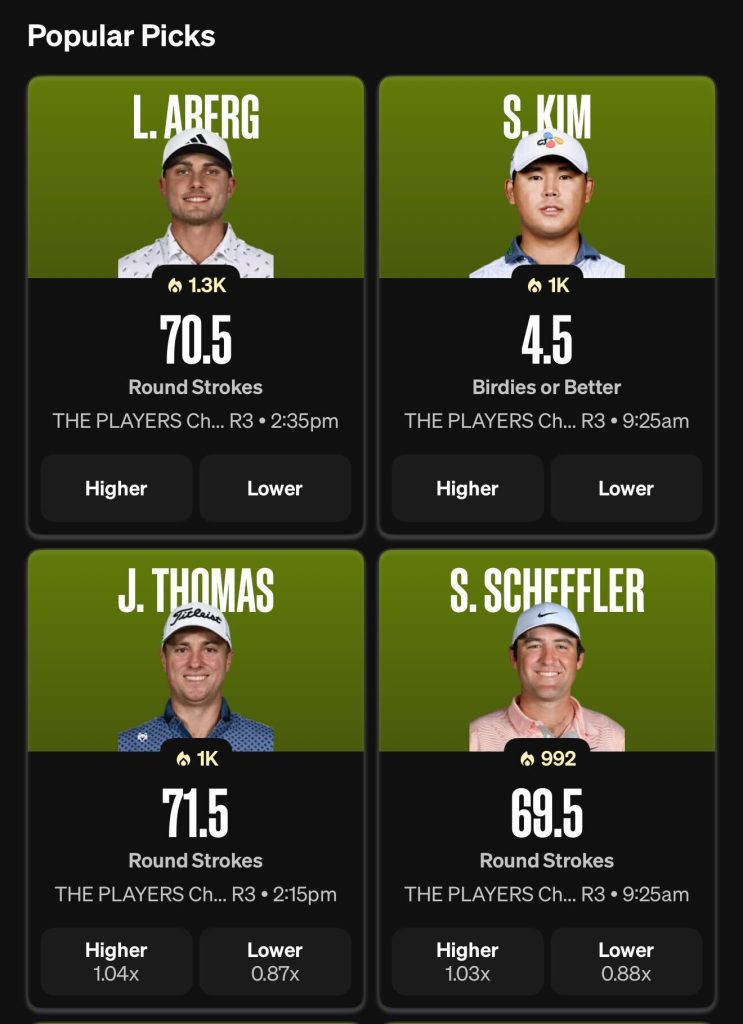
A few of the most popular players for Round 3 on the Underdog app:
Top Round 3 Plays
A quick overview of our favorite golfers
Scottie Scheffler < 69.5 Round Strokes
Russell Henley < 70.5 Round Strokes
Hideki Matsuyama < 70.5 Round Strokes
Check back for finalized picks and analysis.
Good luck!
Editor’s Note: Did you know DFS pick’em apps like Underdog and Sleeper are live in many states where online sports betting isn’t yet legal? Use promo code PROPS to get top-tier sign-up bonuses!
PGA Strategy – Golf Props & DFS Tips
Betting on golf is in many ways a completely different animal than normal head-to-head sports betting.
However, fundamentally it is the same baseline proposition: can we find expected value against the value offered by the marketplace?
The situation is skewed, because in golf win betting we are often dealing with tournament results and not head-to-head results, which give us tantalizing payouts and maddening near-misses on odds that are dozens to hundreds of times the multipliers of most other sports.
Something to keep in mind: just like in real tournament golf, patience and discipline and belief in your process are key, and one big event can change your entire season.
So, how do we find expected value in golf?
The Importance Of Data
Really simply, we want to find golfers who have a chance of playing better than it seems they are playing.
Buying a data subscription alone and just playing the numbers will NOT make you profitable. The advanced analytics are available to everyone, including oddsmakers.
The key is learning to understand why the data is what it is, is how we can dig into the details to find trends that are actionable.
Sites uses a strict formula to combine past results and recent results to create a projection, and it is the best overall formula anyone has ever made, but what we want to look for are golfers who can make a case that they don’t fit the exact model, and have value that isn’t being captured by projections.
So in layman’s terms, here are some really great ways you can find potential value in a golf tournament field:
Top Sportsbooks in All States



Recent Form
Golfers who have a track record of playing very well, but have had some bad results lately that we expect them to bounce back from (if recent poor results are just due to poor putting alone, this is ideal, as putting is by far the most variable category in golf)
Young golfers whose true value is still increasing every week and hasn’t been captured properly by the modeling timelines that are used by Vegas and Data Golf, as well as being slow to catch the public’s eye.
Golfers who have been playing extraordinarily well lately, but historically aren’t that good, are not well captured by Vegas models.
For example, a golfer having a “breakout” year can be slow to pop in the industry models. This is an especially good situation if we can tie this performance increase to something tangible, such as a swing coach change, an offseason increase in driving distance, or another technique change or injury comeback situation.
In these cases, we want to put particular emphasis on driving and iron play, as these are less likely to be the result of random fluctuations in performance.
Course Fit
The last angle that can sometimes be used to get an edge is extreme course-fit outlier situations. The thing about mathematical models is that they can be weak in truly capturing extreme outliers.
On the PGA Tour, course fit week-to-week is much talked about and a very entertaining aspect of the game for fans and commentators, but it is generally very well accounted for by Vegas, and most tend to over-value these adjustments.
OVERALL FORM AND RATING IS ALWAYS MORE IMPORTANT THAN COURSE-FIT — a good fit for the course should always just be the icing on the cake for a good play.
One thing to look out for is the really extreme length outliers – the very longest and very shortest few courses each season, that truly limit a portion of the field from competing with their best weapons.
This happens in just a few events per year, but it does happen, and there you can find value in a true “specialist” in the field, such as guys who make their career through putting and putting alone, or an absolutely wild bomber who doesn’t gain many strokes through the rest of the bag.
Featured Image Credit: Imagn